What happens when a civilization's ambitions outgrow planets? When the need for living space, energy, and resources demands thinking beyond worlds? The answer lies in megastructures—engineering projects so vast they challenge our conception of what's possible, yet grounded in the laws of physics that govern our universe.
The Scale of Ambition
To understand megastructures, we must first grasp their staggering scale. The International Space Station, humanity's largest space structure, spans 109 meters and weighs 420 tons. A modest O'Neill cylinder would be 32 kilometers long and house millions. A Dyson sphere would encompass an entire star.
Some of these designs, such as rotating habitats and solar-collector swarms, ask nothing of physics beyond very strong materials and an enormous industrial base. Others, like the rigid ringworld or the Alderson disk, run into hard limits on material strength or stability. Telling the two apart is the point of this page.
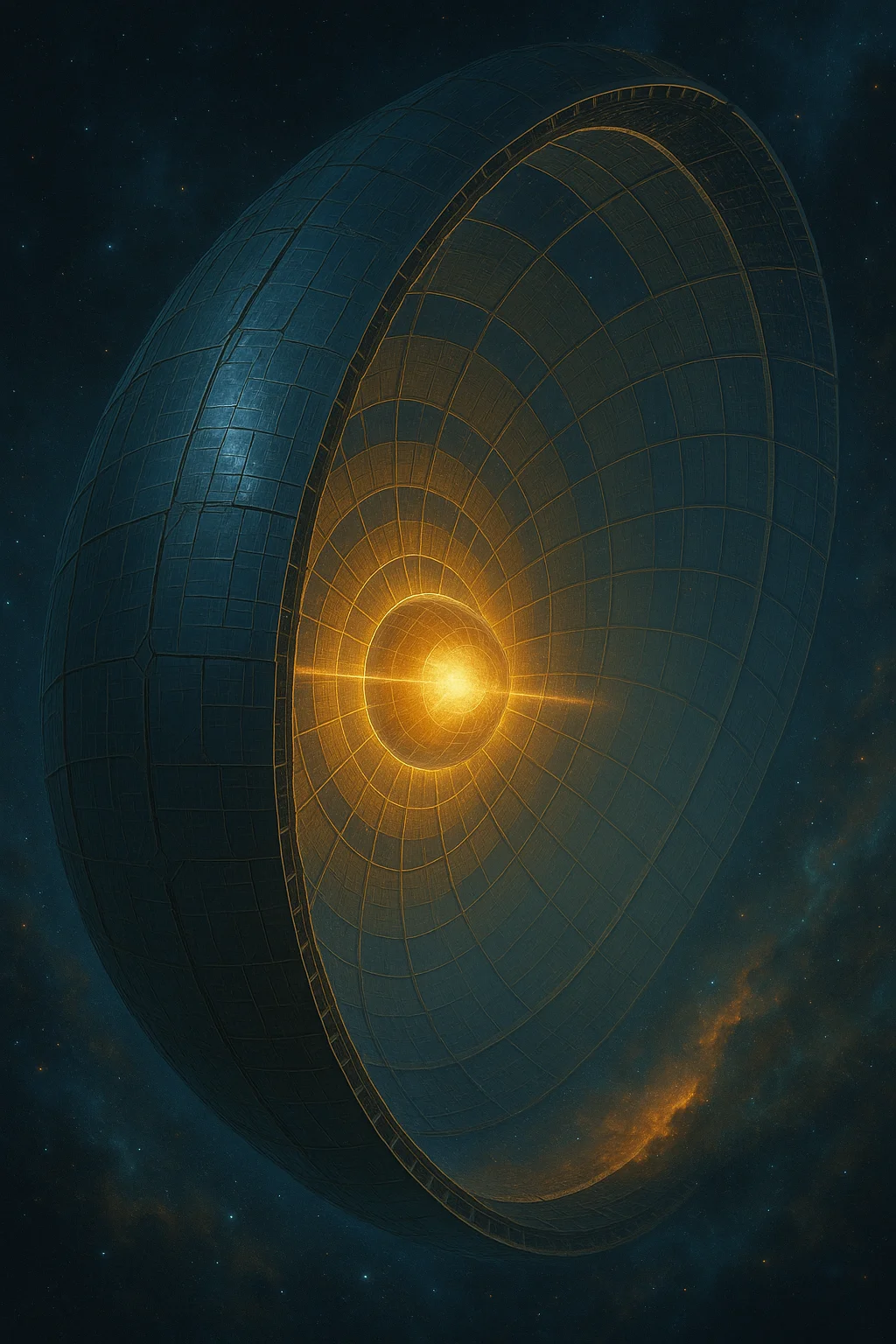
Dyson Spheres: Capturing a Star
In 1960, physicist Freeman Dyson proposed that advanced civilizations would eventually harness all their star's energy. The concept has evolved from a solid shell (physically impossible due to gravitational stresses) to more practical variants:
Dyson Swarm
Millions of solar collectors orbiting a star in a dense cloud, each positioned to avoid shadowing others. This approach offers:
- Scalability: Start small, add collectors over centuries
- Flexibility: Individual units can be maintained or replaced
- Coverage: In principle a dense enough swarm could intercept most of the star's output, though collectors would still have to radiate waste heat
- Materials: Could be built by dismantling a single planet
Dyson Bubble
Stationary collectors held in place by light pressure from the star itself. These "statites" would use vast solar sails to maintain position without orbiting, creating a more uniform energy collection system.
Stellar Engine
A partial Dyson sphere designed not just to collect energy but to move the entire star system. By directing stellar output asymmetrically, civilizations could migrate their home star over millions of years.
Megastructures are the architecture of civilisations that have, by definition, outgrown their home planet. They are also a useful stress test for the Kardashev scale, which classifies civilisations by the scale at which they harvest energy — from a single planet's available sunlight, to the entire output of a star, to the full luminosity of a galaxy. Structures in the second tier are what the rest of this article is about.
Ringworlds: A Band of Earth
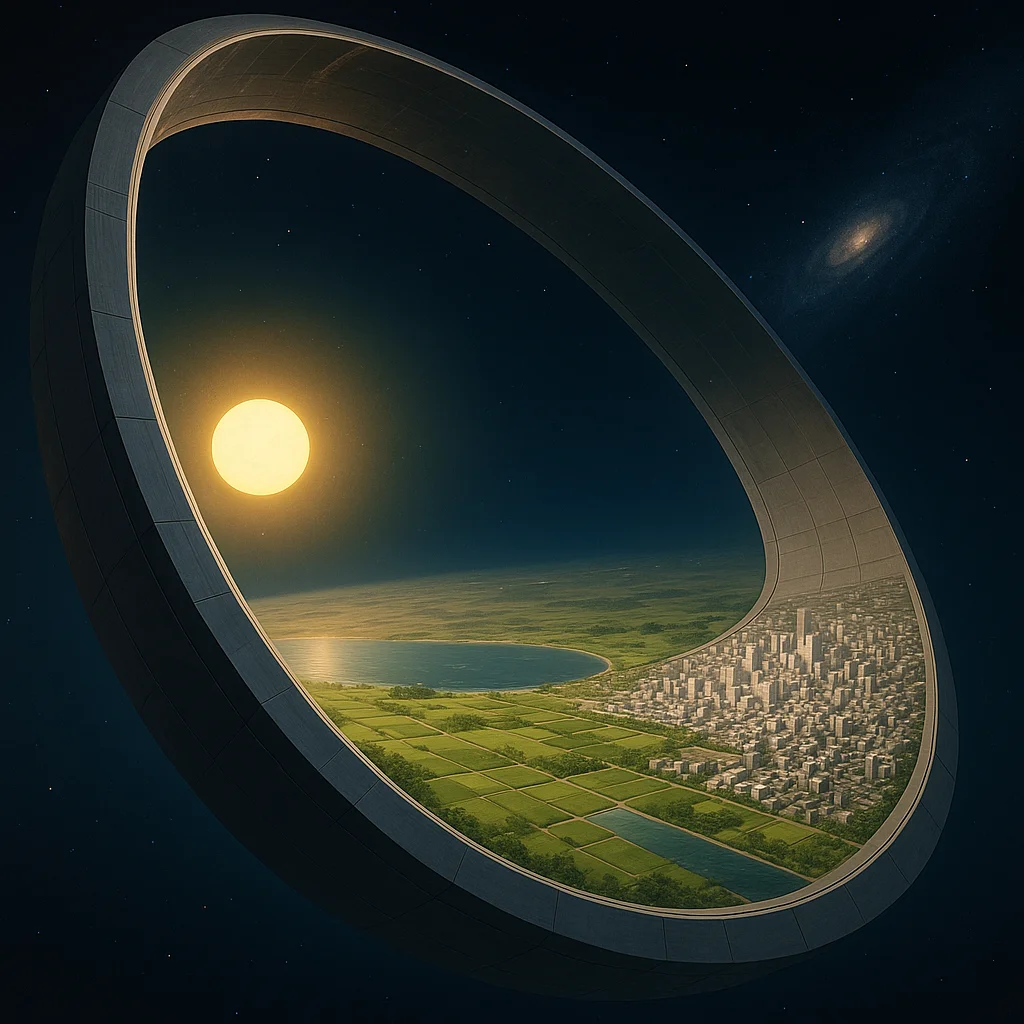
Larry Niven's Ringworld captured imaginations: a ribbon of solid matter circling a star at Earth's orbital distance, with a surface area millions of times greater than our planet. While Niven's original design had stability issues, modified versions could work:
The Classic Ringworld
- Radius: 1 AU (150 million km)
- Width: about 1.6 million km (one million miles) in Niven's novel
- Surface Area: 3 million times Earth's
- Spin: Provides artificial gravity through centripetal force
- Walls: rim walls about 1,600 km (1,000 miles) high to retain atmosphere
Orbital Ring Systems
More modest but still massive: rings around planets rather than stars. These could:
- Provide space elevators at any latitude
- Support hanging cities in the upper atmosphere
- Generate planet-wide transportation networks
- Serve as launch platforms for interplanetary travel
Space Habitats: Worlds We Build
O'Neill Cylinders
Proposed by Gerard K. O'Neill in 1976, these rotating cylinders would provide Earth-like gravity through spin:
- Dimensions: 32 km long, 6.5 km diameter
- Population: Up to 20 million people
- Gravity: Full Earth gravity at the rim
- Atmosphere: Earth-normal, retained by spin
- Day/Night: Mirrors direct sunlight, adjustable for any cycle
Stanford Torus
A wheel-shaped habitat 1.8 km in diameter, housing 10,000 people in suburban comfort. The design includes:
- Radiation shielding from lunar regolith
- Agricultural areas for food self-sufficiency
- Industrial facilities in zero-G hub
- Backup systems for all critical functions
Bishop Rings
Using carbon nanotubes, these structures could be far larger than O'Neill cylinders:
- Diameter: 2,000 km
- Surface Area: Comparable to India
- Population Capacity: Billions
- Unique Feature: Large enough for weather systems
Shkadov Thrusters: Moving Stars
Perhaps the most audacious megastructure: a stellar engine that moves entire star systems. A massive mirror placed near a star reflects radiation in one direction, creating thrust:
- Speed: for a Sun-like star, about 20 m/s after one million years and about 20 km/s after a billion years (Shkadov's 1987 estimate)
- Distance: roughly 0.03 light-years in the first million years, and tens of thousands of light-years over a billion years
- Purpose: Escape supernovae, stellar collisions, or galaxy mergers
- Side Effect: The ultimate "Not In My Backyard" solution
Alderson Disks: Ultimate Living Space
A disk with a star at its center, millions of kilometers in radius with millions of times Earth's surface area. The engineering challenges are immense:
- Gravity varies with distance from center
- Day/night cycles require artificial means
- Material strength beyond current technology
- But provides living space for trillions
Matrioshka Brains: Computing Megastructures
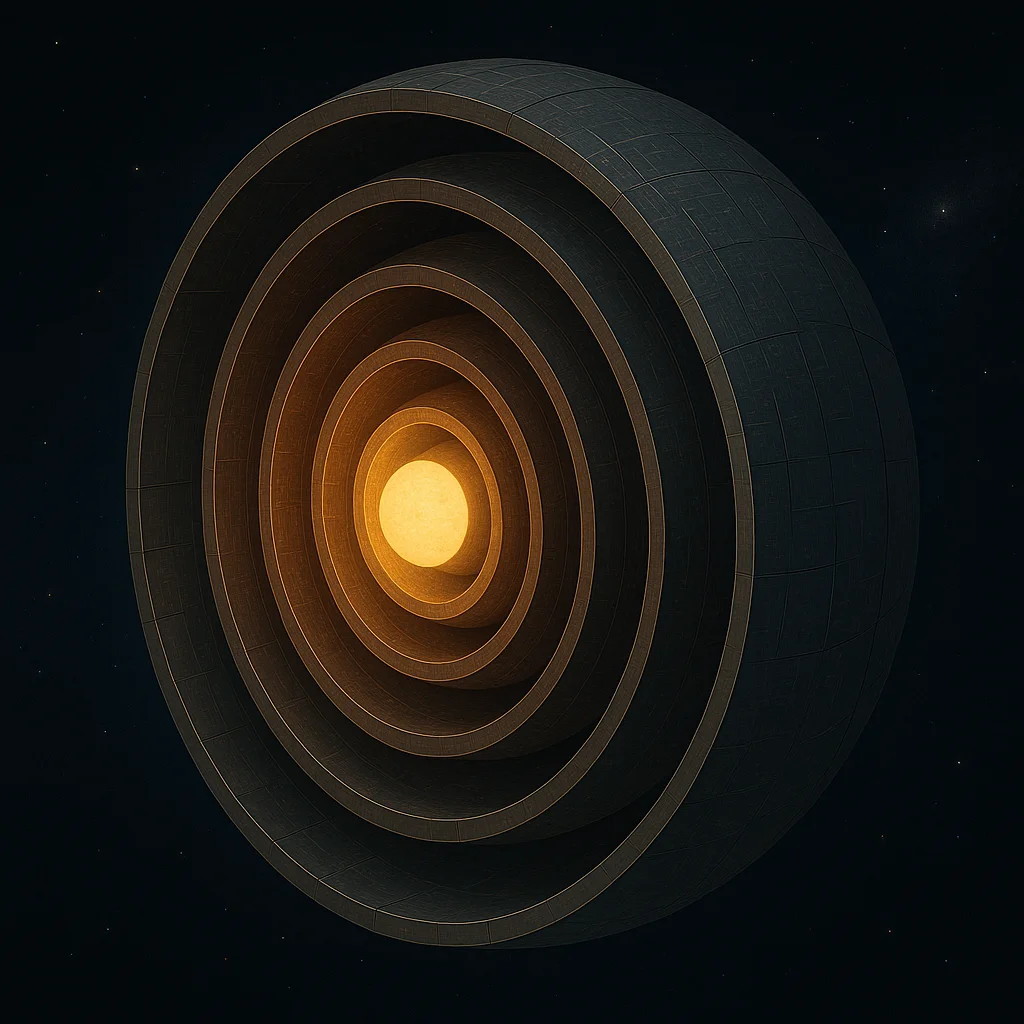
Named after Russian nesting dolls, these are nested Dyson spheres optimized for computation rather than habitation:
Structure
- Inner Shell: High-temperature processors using stellar energy directly
- Middle Shells: Progressively cooler, using waste heat from inner layers
- Outer Shell: Ultra-cold processors for maximum efficiency
- Total Power: 10²⁶ watts dedicated to computation
Capabilities
A Matrioshka brain could:
- Simulate billions of human minds in perfect detail
- Run simulations far beyond anything possible on a planet, though physics still limits how much any finite computer can model
- Solve currently impossible mathematical problems
- Host digital civilizations of unimaginable complexity
Solar Collectors: From Space Solar Power to Dyson Swarms
The most realistic first step toward any stellar-scale structure is already being studied: collecting sunlight in space and using it there or beaming it down. A Dyson swarm is, in effect, the same idea scaled up by many orders of magnitude.
- Space-based solar power. Peter Glaser proposed solar power satellites in 1968: huge arrays in orbit, above clouds and night, converting sunlight to microwaves beamed to receiving antennas on the ground. Studies since the 1970s have repeatedly found the physics sound and the launch and assembly costs the obstacle.
- Real demonstrations. In 2023 Caltech's Space Solar Power Demonstrator transmitted power wirelessly in orbit and detected some of it on the ground, a small but genuine first. ESA has studied the concept under its SOLARIS initiative, and Japan, China and the UK have their own research programmes.
- Scaling up. A single gigawatt-class power satellite would need several square kilometres of collectors, already a megastructure by today's standards. A Dyson swarm would mean billions of such collectors around the Sun, built from mined asteroids or a disassembled planet rather than launched from Earth.
- What limits a swarm. Collectors must not shade each other, must radiate their waste heat, and need active station-keeping; a densely packed swarm is a traffic-management problem as much as a materials one.
Megastructures on a Planet's Surface
Building upward from the ground is limited by gravity and material strength. A solid structure's own weight crushes its base; on Earth this is why the tallest mountains top out at around 9 km above sea level, and why even very strong materials would struggle to support a static tower tens of kilometres high. Three families of ideas get around this:
- Tension instead of compression. A space elevator hangs a cable from beyond geostationary orbit, held taut by the rotation of the planet. It needs a material with a strength-to-weight ratio better than anything yet made in bulk; carbon nanotubes and graphene are strong enough in the lab, not yet at cable scale.
- Dynamic support. Orbital rings (Paul Birch, 1982) and launch loops (Keith Lofstrom, 1981) hold structures up with fast-moving streams of mass that push outward as they are bent around the planet. They need no exotic materials, but they store enormous kinetic energy and fail catastrophically if the stream is disrupted.
- Simply hovering it. Holding a huge structure up with rocket or fan thrust needs continuous power proportional to its weight forever, which is why no serious design does it. For anything city-sized the energy bill is prohibitive; dynamic support works only because the moving mass recycles its momentum rather than throwing it away.
That is why most megastructure concepts live in space, where there is no weight to support and spin can supply artificial gravity.
Construction Challenges
Materials
Building megastructures requires materials far beyond current technology:
- Carbon Nanotubes: For tensile strength in rotating habitats
- Graphene: For solar collectors and radiators
- Metamaterials: For radiation shielding and thermal management
- Self-Healing Alloys: For long-term structural integrity
Assembly
Construction would likely involve:
- Self-Replicating Robots: Exponential manufacturing capability
- Asteroid Mining: Raw materials without planetary gravity wells
- 3D Printing: In-space manufacturing of components
- Swarm Intelligence: Coordination of millions of construction units
Timescales (illustrative guesses)
No one can schedule these projects; the figures below are order-of-magnitude guesses that appear in the speculative literature, assuming a mature space industry:
- Small Habitat (Stanford Torus): 20-50 years
- O'Neill Cylinder: 50-100 years
- Dyson Swarm (partial): 100-1,000 years
- Complete Dyson Sphere: 10,000-100,000 years
Why Build Megastructures?
Living Space
Earth's surface area: 510 million km². A single Bishop Ring: about 3 million km² (roughly the land area of India). A Dyson sphere at 1 AU: about 2.8 × 10¹⁷ km², some 550 million times Earth's surface.
Energy
The Sun outputs 3.8 × 10²⁶ watts. Earth receives only 1.7 × 10¹⁷ watts—one 2.2-billionth of solar output. A Dyson sphere captures it all.
Survival
Megastructures offer ultimate redundancy. A ringworld can survive local disasters that would devastate a planet. A mobile star system can escape cosmic threats.
Evolution
Perhaps megastructures represent a natural stage in the development of intelligent life—the point where civilizations graduate from planetary to stellar scale.
Detection and Search
If other civilizations build megastructures, we might detect them:
Dyson Sphere Signatures
- Infrared Excess: Waste heat from energy use
- Stellar Dimming: Partial obscuration of starlight
- Unusual Spectra: Artificial elements in stellar atmosphere
Projects like SETI and Breakthrough Listen search for technosignatures, and astronomers have combed infrared sky surveys for stars with unexplained heat excess. The best-known candidate, Tabby's Star (KIC 8462852), turned out to be dimmed by dust. A 2024 search (Project Hephaistos) flagged seven M-dwarf stars with infrared excess as possible partial Dyson spheres; follow-up work suggested background galaxies were a likelier explanation. No megastructure has been confirmed.
The Path to Megastructures
Near Term (this century, speculative)
- Rotating space stations demonstrating artificial gravity
- Large solar power satellites beaming energy to Earth
- Asteroid mining providing space-based materials
- First permanent space habitats (100-1,000 people)
Medium Term (2100-2500)
- O'Neill cylinders at Earth-Moon Lagrange points
- Orbital rings around Earth enabling cheap space access
- Self-replicating robotic miners in asteroid belt
- Population in space exceeds 1 million
Long Term (2500+)
- Bishop Rings housing billions
- Partial Dyson swarms for energy collection
- Shkadov thrusters for stellar repositioning
- Humanity becomes a true spacefaring civilization
The Ultimate Expression
Megastructures represent more than engineering achievements—they're statements of intent. A species that builds a Dyson sphere declares its permanence in the universe. A civilization that constructs ringworlds has chosen to create rather than simply inhabit.
These structures challenge us to think beyond the constraints of planetary life. They ask: What could humanity become with unlimited energy and space? How would our culture, philosophy, and dreams evolve when scarcity becomes meaningless and the only limits are imagination and the laws of physics?
Today, megastructures remain in the realm of theory and fiction. But every space station we build, every asteroid we mine, every advance in materials science brings them closer to reality. They wait in our future—monuments to ambition, testimonies to what intelligence can achieve given time and will.
The universe is vast and full of wonders. But perhaps the greatest wonders will be those we build ourselves, when humanity's children dance in structures that dwarf worlds, powered by captive stars, reaching toward a destiny written in steel and light across the cosmos.