SpaceX's Starship is the largest and most powerful rocket ever flown: a stainless-steel, two-stage vehicle about 120 metres tall that SpaceX intends to be fully and rapidly reusable. It is also the lander NASA picked to put Artemis astronauts on the Moon, and the vehicle SpaceX says it will use to send cargo and eventually people to Mars. This page covers how it works, what it has actually demonstrated in flight, and how its headline numbers should be read.
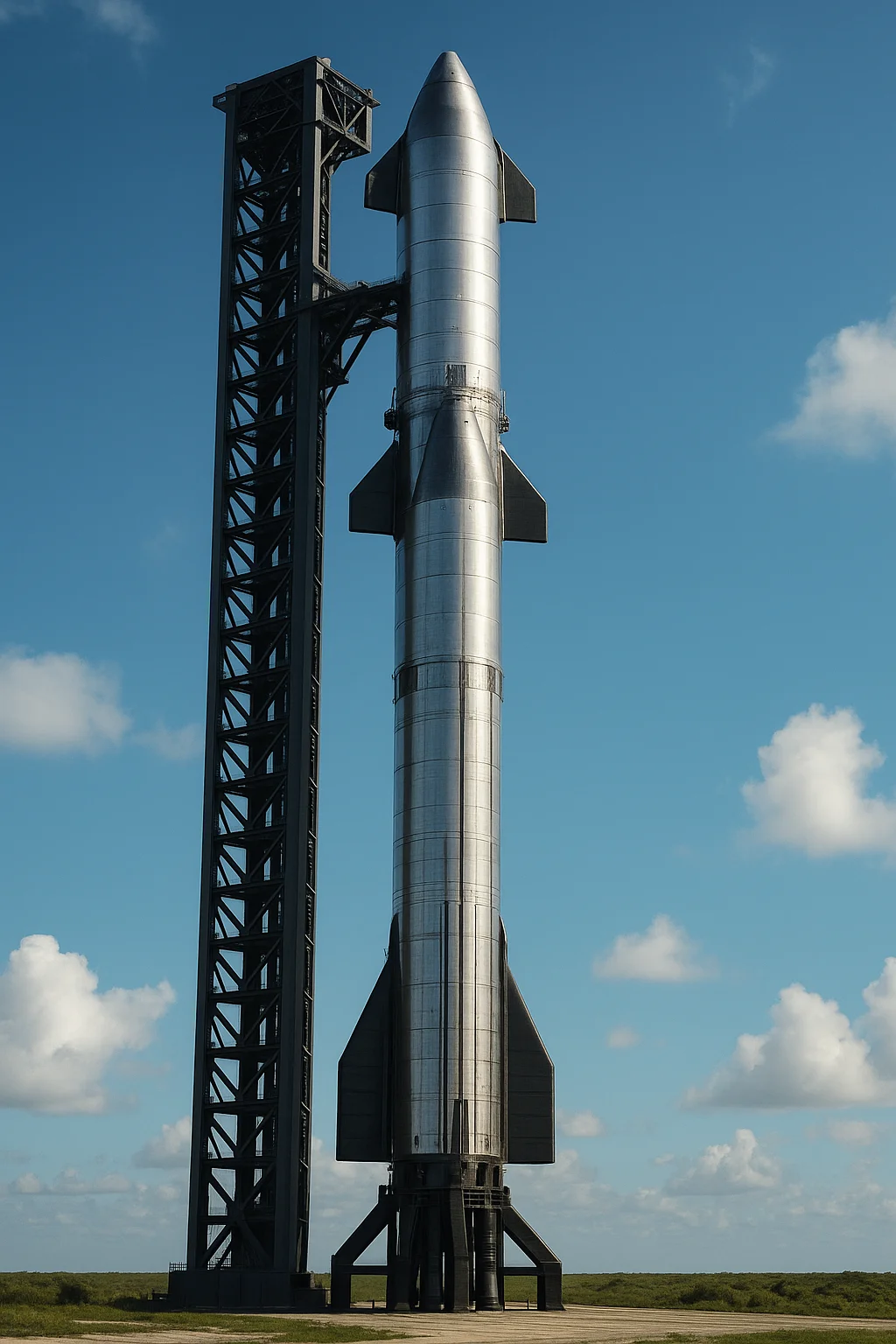
The Two Stages
- Super Heavy booster: about 70 metres tall, with 33 Raptor engines. It returns to the launch site and, since October 2024, can be caught in mid-air by the launch tower's "chopstick" arms instead of landing on legs.
- Starship (the ship): about 50 metres tall, with six Raptors (three optimised for sea level, three for vacuum). It carries the payload, survives re-entry on a heat shield of hexagonal ceramic tiles, and uses large flaps to control its belly-first descent before flipping upright for landing.
The stack has grown with each version. The "Version 2" vehicles that flew in 2025 stood about 123 metres tall; the larger Version 3, with upgraded Raptor 3 engines, was being prepared to fly from a new launch pad at Starbase in 2026.
The Raptor Engine
Raptor burns liquid methane and liquid oxygen in a full-flow staged combustion cycle, and it was the first engine of that type to fly. Both propellants pass through their own preburner and turbine before meeting in the main combustion chamber. In principle the architecture yields very high chamber pressure, high specific impulse, and low parasitic losses. In practice it also produces a hot, hard-running engine that is demanding to manufacture; keeping Raptor production high enough for a fully reusable programme is as much of an engineering story as the engine itself.
Methane was chosen partly for Mars: it can in principle be made there from atmospheric carbon dioxide and water ice, which is how SpaceX plans to refuel ships for the return trip.
Flight Test History
SpaceX develops Starship by flying early and fixing what breaks. That makes the record uneven, and worth reading in order.
- 2019–2021: Single-engine "hops" (Starhopper) and high-altitude tests of the ship alone, ending with SN15's successful landing in May 2021.
- 20 April 2023 — Flight 1: First full stack. Several engines failed, the stages did not separate, and the vehicle was destroyed about four minutes after launch.
- 18 November 2023 — Flight 2: First successful "hot staging"; both stages were lost later in the flight.
- 14 March 2024 — Flight 3: The ship reached its planned trajectory but broke up during re-entry.
- 6 June 2024 — Flight 4: Both booster and ship made controlled splashdowns for the first time.
- 13 October 2024 — Flight 5: The first booster catch by the launch tower.
- January–May 2025 — Flights 7, 8 and 9: The first Version 2 ships were lost each time (twice during ascent, once after losing attitude control in space), although boosters were caught on Flights 7 and 8. A ship also exploded during ground testing in June 2025.
- 26 August and 13 October 2025 — Flights 10 and 11: Two successful flights that deployed dummy Starlink satellites in space, re-lit a Raptor in space, and ended with controlled ship splashdowns in the Indian Ocean, closing out Version 2.
As of our last review, Starship had not yet reached a stable orbit with a real payload, caught a ship on the tower, or demonstrated the large-scale ship-to-ship propellant transfer that Moon and Mars missions require. Those are the milestones to watch.
Payload and Capacity: Reading the Numbers
Starship figures are often quoted without context. Three things help:
- Payload to orbit. SpaceX's goal is more than 100 tonnes to low Earth orbit with both stages recovered, rising with later versions. Expending the vehicle would allow more. Flights so far have carried only test payloads.
- Beyond Earth orbit. A ship reaching orbit has used most of its propellant. To go to the Moon or Mars with a large payload it must be refilled in orbit by a series of tanker Starships. How many tanker flights are needed per mission has been one of the big open questions for the lunar lander.
- Passengers. SpaceX has spoken of eventually carrying up to about 100 people per ship to Mars. That is a long-term aspiration for a vehicle that has not yet flown a crew; no crewed Starship flight has been scheduled publicly.
Mission Roles
Artemis lunar lander
NASA selected a lunar version of Starship as the Human Landing System for Artemis in 2021. It would take astronauts from lunar orbit to the surface and back, with far more cabin volume than any previous lander. Before it can carry crews it must perform an uncrewed lunar landing demonstration. See Human Landing Systems.
Mars
SpaceX has said it wants to send uncrewed Starships to Mars in the launch window that opens in late 2026, with crews to follow in later windows. These are company goals, and Mars windows only come every 26 months. See current Mars missions for what is actually there today.
Starlink and point-to-point travel
In the near term, Starship's commercial job is launching larger Starlink satellites. SpaceX has also floated using it for rocket travel between cities on Earth; that remains a concept with no announced service.
Why It Matters
If Starship achieves rapid full reuse, the cost and mass limits that have shaped every space mission since the 1960s change: large telescopes, space stations launched in one piece (Starlab is designed to fly on Starship), and big lunar and Martian cargo deliveries all become easier. If it achieves only part of that, it is still a very large rocket. The flight record is the place to judge which future is arriving, not the renderings.
For the rocket that currently does most of the world's launching, see Falcon 9 and Dragon.