Mars is the busiest destination beyond the Moon. In 2026 two rovers are working on the surface and up to seven orbiters from four space agencies circle overhead, with more spacecraft on the way. This page lists every mission currently at Mars, who runs it, and its status as we last reviewed it, plus what is heading there next.
How current is this? Mission status changes: spacecraft run out of propellant, lose contact, or get extended. The list below reflects public information from the agencies as of our last review (date at the bottom of the page). For live status, check each agency's mission page.
Quick Answer: How Many Missions Are at Mars?
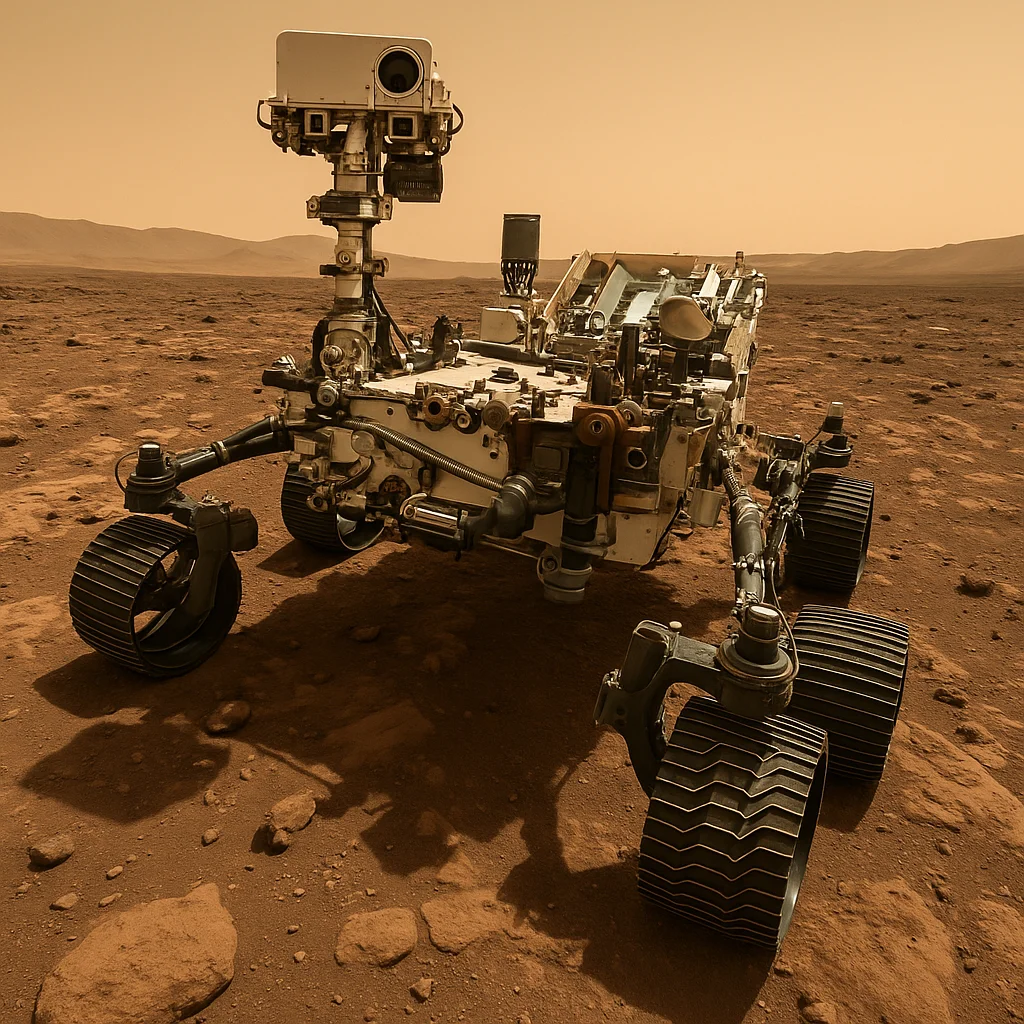
- On the surface: 2 working rovers, both NASA's: Curiosity and Perseverance.
- In orbit: 7 orbiters launched by NASA (3), ESA (2, one with Roscosmos), the UAE (1) and China (1). One of the NASA orbiters, MAVEN, stopped communicating in December 2025.
- NASA specifically: five Mars missions were operating until late 2025 (Odyssey, Mars Reconnaissance Orbiter and MAVEN in orbit; Curiosity and Perseverance on the ground). Since MAVEN fell silent, NASA has had two orbiters in contact.
Rovers on the Surface
Perseverance (NASA)
Launched 30 July 2020 and landed in Jezero Crater on 18 February 2021. Jezero held a lake about 3.5 billion years ago, and Perseverance's job is to look for signs of ancient microbial life and to collect rock cores in sealed tubes for possible return to Earth. It carries 43 sample tubes; ten filled tubes were left in a depot on the crater floor at "Three Forks" in 2022–2023 as a backup. The rover has since climbed out of the crater onto its rim. Whether those samples ever come home depends on the Mars Sample Return programme, whose future is uncertain (see below).
Perseverance carried the Ingenuity helicopter, which made the first powered, controlled flight on another planet on 19 April 2021. Ingenuity flew 72 times before rotor blade damage ended its mission in January 2024; it remains on the surface.
Curiosity (NASA)
Launched 26 November 2011 and landed in Gale Crater on 6 August 2012 (UTC). Curiosity established that Gale Crater once held lakes with water chemistry that could have supported microbes, and it has detected organic molecules in ancient mudstones. It is slowly climbing the layered slopes of Mount Sharp, reading the planet's transition from wet to dry like pages in a book. In 2026 it has been on Mars for more than 5,000 sols (Martian days).
Missions no longer active on the surface
China's Zhurong rover landed in Utopia Planitia in May 2021 and went into planned hibernation in May 2022; it has not been heard from since. NASA's InSight lander ended in December 2022 when dust covered its solar panels. Earlier rovers Spirit (to 2010), Opportunity (to 2018) and Sojourner (1997) are long finished.
Orbiters
- 2001 Mars Odyssey (NASA) — in orbit since October 2001, the longest-working spacecraft at Mars. It maps surface minerals and ice and relays rover data. It has been running very low on propellant, so its end is near.
- Mars Express (ESA) — in orbit since December 2003. Radar soundings, high-resolution stereo imaging and atmospheric studies.
- Mars Reconnaissance Orbiter (NASA) — in orbit since March 2006. Its HiRISE camera can resolve objects about a metre across, and it is the main relay for surface missions.
- MAVEN (NASA) — in orbit since September 2014, studying how the solar wind stripped away most of Mars' atmosphere. NASA lost contact with MAVEN in early December 2025. Check NASA for whether contact has been restored.
- ExoMars Trace Gas Orbiter (ESA/Roscosmos) — in orbit since October 2016. It measures trace gases such as methane and relays data for NASA's rovers.
- Emirates Mars Mission "Hope" (UAE) — in orbit since February 2021, studying Mars' weather and climate across the whole planet and every time of day.
- Tianwen-1 orbiter (China) — in orbit since February 2021. It delivered the Zhurong rover and continues remote sensing and relay work.
India's Mars Orbiter Mission (Mangalyaan), in orbit from 2014, lost contact in 2022 and has ended.
On the Way, and Next in Line
- ESCAPADE (NASA) — twin small orbiters built by Rocket Lab to study how the solar wind interacts with Mars' patchy magnetic fields. Launched 13 November 2025 on the second flight of Blue Origin's New Glenn rocket. Instead of flying straight to Mars, the pair first wait near the Sun–Earth L2 point and then use an Earth flyby, with arrival at Mars planned for 2027.
- Martian Moons eXploration, MMX (JAXA) — Japan's mission to land on Phobos, collect a sample and return it to Earth. Launch has been targeted for 2026 on an H3 rocket, with sample return around 2031.
- Rosalind Franklin rover (ESA) — Europe's drilling rover, delayed by the end of cooperation with Russia in 2022. ESA now plans a 2028 launch with NASA providing launch and other contributions.
- Tianwen-3 (China) — a Mars sample-return mission China has said it aims to launch around 2028, with samples back around 2031.
- Mars Sample Return (NASA/ESA) — the plan to bring Perseverance's samples home. Cost growth led NASA to review the architecture in 2024, and the White House's fiscal year 2026 budget request proposed ending the programme in its existing form. Treat any return date as unknown until a funded plan is confirmed.
- SpaceX Starship — SpaceX has said it wants to send uncrewed Starships to Mars in a launch window that opens in late 2026. That is a company aspiration, not a scheduled mission; see Starship for where the vehicle's testing stands.
Mars launch windows open roughly every 26 months, when Earth and Mars line up for the most efficient transfer. That is why Mars missions cluster in particular years, and why a slipped launch often means a two-year delay.
Why So Many Missions Go to Mars
Three reasons. Mars is reachable: a transfer takes six to nine months and the delta-v cost is modest. It is knowable: its surface is visible from orbit and its rocks preserve a record of a wetter, possibly habitable past. And it is the long-term target for human exploration, so every mission doubles as a scouting trip. For the planet itself, see Mars: The Red Planet; for the far-future version, see Building a Mars Colony.
Frequently Asked Questions
How many NASA missions are currently in orbit around Mars?
Three NASA orbiters have been at Mars: 2001 Mars Odyssey, the Mars Reconnaissance Orbiter and MAVEN. NASA lost contact with MAVEN in December 2025, so two NASA orbiters were in contact as of our last review. NASA also operates two rovers on the surface, Curiosity and Perseverance.
What rovers are active on Mars right now?
Two: NASA's Curiosity (in Gale Crater since 2012) and Perseverance (in and around Jezero Crater since 2021). China's Zhurong rover has been dormant since May 2022.
Which countries have spacecraft at Mars?
The United States (NASA), Europe (ESA, including the ExoMars orbiter built with Roscosmos), the United Arab Emirates (Hope) and China (Tianwen-1). India's orbiter ended in 2022.
What is the next mission to Mars?
NASA's ESCAPADE twin orbiters, launched in November 2025, are due to reach Mars in 2027. Japan's MMX mission to the moon Phobos has been targeted for launch in 2026.