The stars beckon, but they are impossibly far away. Even traveling at the speed of light, it would take over four years to reach our nearest stellar neighbor. But what if we could break Einstein's cosmic speed limit? What if faster-than-light travel isn't just science fiction?
The Challenge of Interstellar Distance
Space is vast beyond human comprehension. The nearest star system, Proxima Centauri, lies 4.24 light-years away—about 40 trillion kilometers. At Voyager 1's speed of about 17 km/s it would take more than 70,000 years to make the journey; even the far faster Parker Solar Probe, if it could hold its peak speed, would need several thousand years. For humanity to become a truly interstellar species, we need something revolutionary.
The Alcubierre Warp Drive
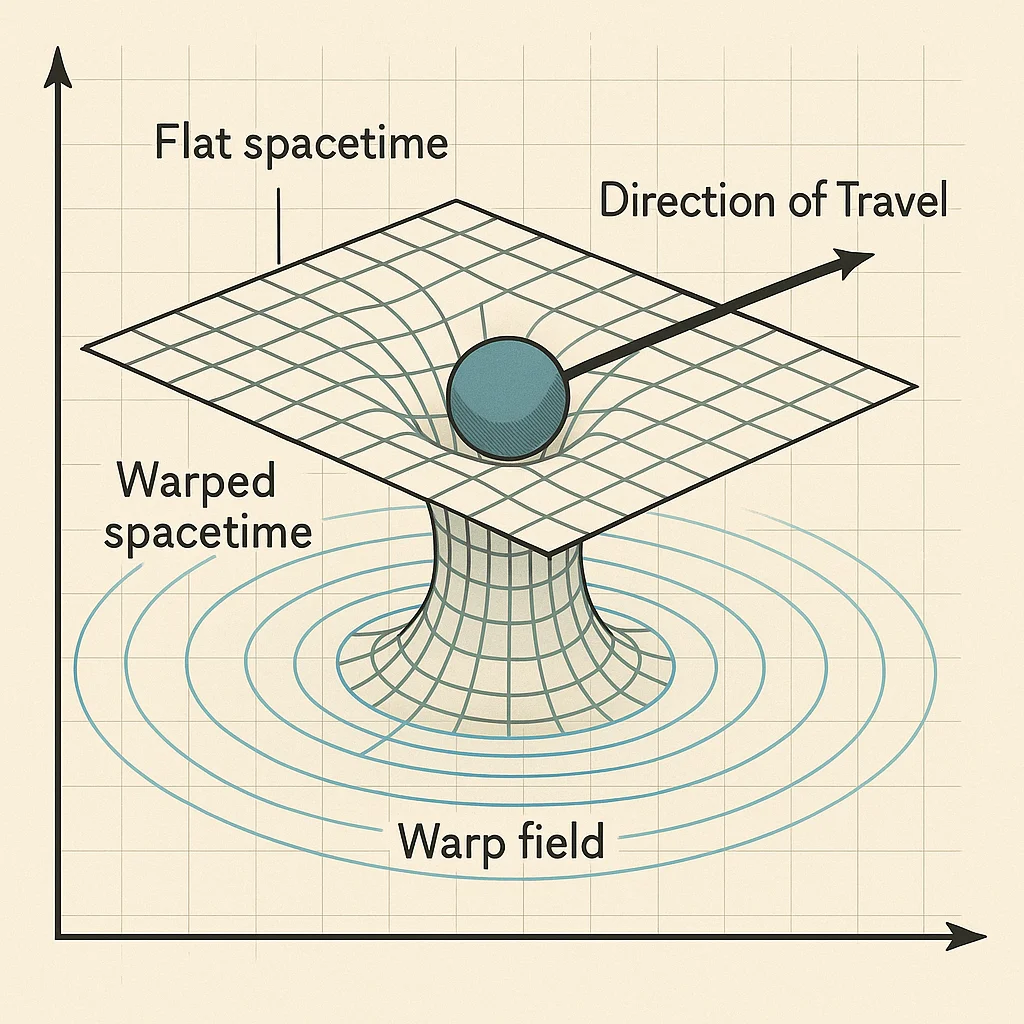
In 1994, physicist Miguel Alcubierre proposed a startling solution: don't move through space, move space itself. The Alcubierre drive would compress space in front of a spacecraft and expand it behind, creating a "warp bubble" that carries the ship faster than light relative to the outside universe.
The Alcubierre metric, published in 1994, is often summarised in popular writing as a recipe for a warp drive. It is more accurately a theorem: Einstein's equations admit a spacetime geometry in which a bubble of flat space is pushed through the surrounding spacetime at an effective speed greater than light, without anything inside the bubble locally exceeding c. The theorem exists. Whether the stress-energy that the theorem requires could ever be assembled is a separate question.
The mathematics work out—Einstein's field equations do allow for such exotic geometries. The catch? It requires "exotic matter" with negative energy density, something that may not exist in the quantities needed.
Recent Developments
Theorists have spent three decades trying to shrink or sidestep the exotic-matter requirement. The results are interesting, but none of them is a working design:
- 1999–2012: Chris Van Den Broeck showed that reshaping the bubble could cut the required negative energy dramatically, and Harold White, then at NASA, argued in 2012 that an oscillating, thick-walled bubble might reduce it further, to roughly the mass-energy of a large spacecraft. These remain theoretical estimates, and White's figure in particular has not been widely accepted.
- 2021: Erik Lentz proposed "soliton" warp solutions built from positive energy alone. Other physicists disputed whether they truly avoid negative energy, and they would still need astronomical amounts of energy.
- 2021–2024: Alexey Bobrick and Gianni Martire set out a general framework for "physical" warp drives, and a 2024 paper by Jared Fell and colleagues presented a constant-velocity warp solution that satisfies the standard energy conditions. Both are explicitly slower than light. The most physically respectable warp solutions found so far are, in other words, not faster-than-light drives.
No experiment has created or detected a warp bubble. Occasional headlines about laboratory "warp fields" have referred to calculations about tiny cavity structures, not to anything that moves space.
Traversable Wormholes
Another approach to FTL travel involves shortcuts through spacetime itself. Wormholes—also called Einstein-Rosen bridges—could theoretically connect distant regions of space through a higher-dimensional tunnel.
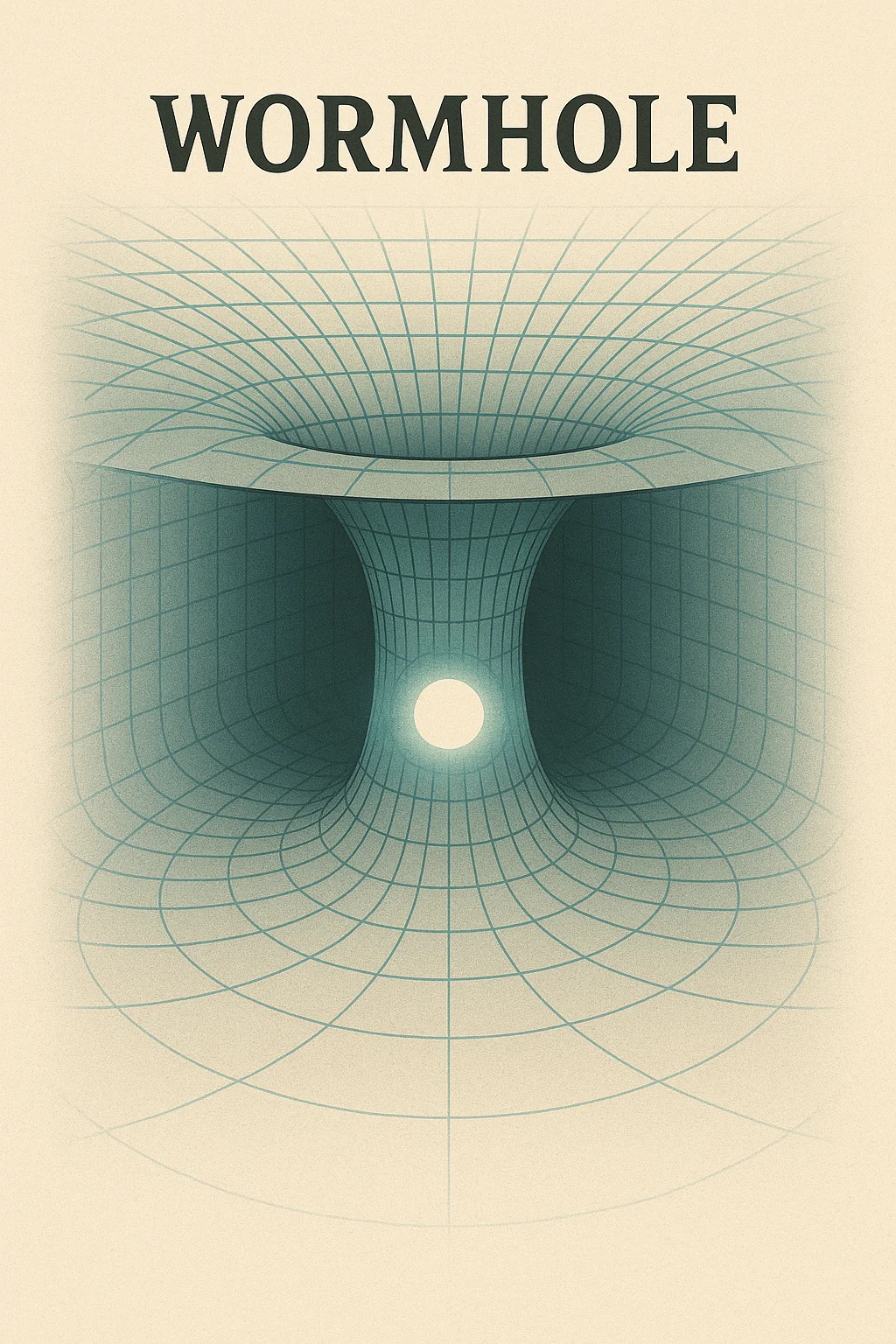
Unlike the warp drive, wormholes don't require moving faster than light at all. Instead, they provide a shortcut, like a tunnel through a mountain rather than going over it. The challenges are formidable:
- Natural wormholes, if they exist, would be microscopic and unstable
- Keeping a wormhole open requires exotic matter threading its throat
- Creating an artificial wormhole would require manipulating spacetime on a cosmic scale
Quantum Entanglement and Information
Entanglement is often suggested as a loophole, and it is not one. Measuring one of a pair of entangled particles does produce results correlated with measurements of its distant partner, but the outcomes are random, and the correlation only shows up when the two sets of results are compared over an ordinary, light-speed channel. The no-communication theorem shows that entanglement alone cannot send a message, faster than light or otherwise. It underpins quantum cryptography and quantum teleportation of states (which also needs a classical signal), but it will not give an interstellar civilisation instant messaging. Science fiction's "ansible" remains fiction.
Every Proposed Route to FTL, Compared
Strip away the vocabulary and there are only a handful of ideas on the table. Here is how they stand against known physics.
- Warp drive (Alcubierre metric and successors): allowed by general relativity on paper; needs negative energy density in amounts nobody knows how to produce. Physically "respectable" versions found so far are slower than light.
- Krasnikov tube: a proposed spacetime "tube" laid down on a first, slower-than-light trip that would allow fast return journeys. It has the same exotic-matter problem as the warp drive.
- Traversable wormholes: solutions of general relativity (Morris and Thorne, 1988) that need exotic matter to hold the throat open. No natural wormhole has ever been observed.
- Tachyons: hypothetical particles that always travel faster than light. None has ever been detected, and in modern physics a "tachyonic" field usually signals an instability rather than a faster-than-light particle.
- Extra dimensions or "hyperspace": some theories allow extra spatial dimensions, but none gives a known shortcut that ships could use. Hyperspace as fiction uses it is a narrative device.
- Quantum entanglement: cannot carry information faster than light (see above).
- The slower-than-light alternatives: relativistic travel with time dilation, generation ships, and laser-pushed light sails such as the Breakthrough Starshot concept. These are compatible with known physics and are covered in Interstellar Colonization.
For storytellers: a space opera does not strictly need FTL, but without it a galaxy-spanning setting has to accept centuries-long voyages, time dilation separating travellers from home, or both. Our own Starfarer's Codex uses a fictional hyperdrive, and labels it as fiction.
The Energy Problem
Every FTL concept faces the same fundamental challenge: energy. The original Alcubierre drive required energy equivalent to the mass of Jupiter. Even with improvements, we're talking about harnessing energy on a scale that dwarfs our entire civilization's current output.
Potential solutions include:
- Antimatter: The most energy-dense fuel known to physics
- Zero-point energy: Tapping quantum vacuum fluctuations
- Kugelblitz black holes: black holes made from concentrated light, a long-standing speculative power source; a 2024 analysis argued that quantum effects would stop one from forming out of light at all
The Paradox Problem
FTL travel introduces causality paradoxes—in some reference frames, you could arrive before you left, potentially violating cause and effect. Physicists have proposed various solutions, from the Novikov self-consistency principle to quantum mechanics preventing paradoxes altogether.
The Path Forward
The honest summary: general relativity does not flatly forbid faster-than-light geometries, but every known route requires negative energy in quantities no known physics can supply, and most of them would also allow travel into the past, which many physicists take as a sign that some deeper principle rules them out. FTL remains a thought experiment, and a productive one, because it forces precise questions about energy, causality and the structure of spacetime.
The routes to the stars that physics clearly allows are slower: fast robotic probes, light sails, and, eventually, very long voyages by ships carrying people. They are hard, but they are engineering problems rather than physics problems.